Showing posts with label Best Kids Self Defense. Show all posts

Saturday, February 5, 2011

Character for Karate Kids Martial Arts Phoenix


Integrating Martial Arts
and Character Education

The S.T.A.R. Program at USA Martial Arts Phoenix
Kids Martial Arts Phoenix | Learn more about Childrens Martial Arts Arizona

We are excited to feature one of the most exciting and innovative programs you and your child will ever experience in the area of Personal Responsibility Education. The program is called S.T.A.R. in the Martial Arts. STAR stands for Success Through Accepting Responsibility or Stop, Think, Act and Review.
USA Martial Arts Karate Kids
at AZ Diamondbacks Demo
 
As part of our never ending quest to improve our curriculum, we have chosen to implement the S.T.A.R. program because it is a perfect complement to our philosophy. S.T.A.R. provides an ongoing, systematic method of teaching the core values on which our program is based. We believe this to be an ongoing process and not something to be achieved in a month, or year, but rather over a lifetime of education and effort.

USA Martial Arts Phoenix S.T.A.R. is designed to teach a student to:
  • Accept the consequences of their actions.
  • Use the S.T.A.R. Stop, Think, Act, Review decision-making mode to solve problems and resolve conflicts.
  • Develop and improve self-confidence, self-esteem, and positive attitudes.
  • Set and Achieve realistic goals.
  • Accept that attendance at class, punctuality, and reliability, are part of being personally responsible.
S.T.A.R. was developed by the Jefferson Center for Education. The S.T.A.R. program was developed for the academic setting and is currently used by over 5,000 schools and 50,000 classrooms across the country. In total it has reached nearly 2 million students.

S.T.A.R. in the Martial Arts is a program focused on the systematic teaching of common values. These values include: honesty, respect, responsibility, integrity, courage, tolerance, justice, self-confidence, and politeness.


Top Ten Reasons Why Parents Bring Their Kids To USA Martial Arts Phoenix

USA Martial Arts Karate Kids

Top Ten Reasons Why Parents Bring
Their KidsTo USA Martial Arts

Taekwondo, Karate, Kung Fu, Jiu-jitsu for Kids
Scottsdale, Phoenix, Cave Creek, Arizona


Wednesday, March 17, 2010

USA Martial Arts – Karate for Kids Programs Childrens Karate, Taekwondo, Self Defense in Paradise Valley Phoenix Arizona


USA Martial Arts – Karate for Kids Programs
Childrens Karate, Taekwondo, Self Defense in Paradise Valley Phoenix Arizona

We offer several Karate programs for children ranging from basicTaekwondo, Self-defense, Mixed Martial Arts (MMA), Child safety, Leadership, Fitness, life skills building and more.  

Over the years USA Martial Arts has come to realize that there are many reasons for studying Martial Arts and we have worked hard to develop programs that will help realize those goals.  A low Student to Instructor raio is maintained at all times to ensure that nobody gets lost in the crowd.  This has helped establishPARADISE VALLEY MARTIAL ARTS as a leader in the martial arts industry.  We are dedicated to enhancing the physical capabilities and maximizing the self-defense skills of all our students.
 http://USA-MartialArts.com 
602.896.8721

Tuesday, March 16, 2010

“Stranger Danger” Lessons Alone Don't Protect Children Part Two


“Stranger Danger” Lessons Alone
Don't Protect Children 
Part Two


“Parents can teach about personal safety without causing unwarranted fear,” says Dr. Broughton.

What to teach instead:
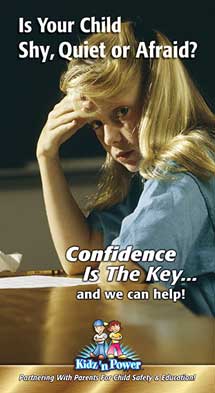
    Is your child quiet, shy or afraid?
  • Children should know their name, address and phone number (with area code) so, if lost, they can be reunited with their family. Older children should know parents' work numbers.


  • Away from home, older children should always be with a friend, always tell an adult where they will be, and say “no” if they feel threatened or uncomfortable.


  • Children need to know that appropriate strangers – store clerks or police officers – can offer assistance if they are lost or need help.


  • Parents need to listen, and respect their children's feelings. Children can sense unease in inappropriate relationships. They'll likely share their concerns if parents routinely take all of their concerns in life seriously rather than downplaying or shaming them.


  • Children need to know that they do not need to kiss, hug, touch or sit on the lap of anyone, relative or not, if they do not wish to. This respect for their wishes translates into self–respect and the ability for children to say no to unwanted contacts without generating fear.


  • Parents need to supervise children who use the Internet. Although still relatively uncommon, the practice of pedophiles and child molesters approaching children on the Internet is occurring more frequently.


  • Parents need to keep reinforcing safety messages through middle school and high school. According to the U.S. Department of Justice, most victims of nonfamily abductions were 12 years or older (58 percent). Most were girls (65 percent).


  • Parents should realize the limitations of participating in programs where children are fingerprinted or otherwise identified. These programs can frighten children and raise fears in adults without giving perspective on the real nature or risk of abduction.


  • Parents should keep on hand a high–quality recent photo of each child, such as a school photo. Law enforcement officials consider photos the best tool in finding missing children.


  • Parents should promptly report a missing child. The Amber Plan, the national program to immediately flood a region with news of an abduction, is credited with helping to recover more than 130 children since it started two years ago.


“None of these safety approaches needs to be taught specifically as safeguarding against abductions – with all its overtones of danger and threat,” says Dr. Broughton. “Instead, safety should be taught as common sense so children can learn confidence and independence.”


Statistics:
Non-Family Abductions

  • In 1999, more than 50,0000 children and adolescents were taken by nonfamily members by physical force or coercion for at least one hour.


  • Ninety–one percent of non–family abductions lasted less than a day, with 29 percent lasting two hours or less.


  • Classic non–family kidnappings pose the greatest risk of death or serious harm. About 100 children were kidnapped by non–family members in 1999.
    (Source: U.S. Department of Justice National Incidence Studies of Missing, Abducted, Runaway, and Thrownaway Children, 2002)


Family Abductions

  • 203,900 children each year are victims of family abductions, where the child is taken by a non–custodial parent.


  • 24 percent of these abductions lasted one week to one month. Police were contacted in 60 percent of the cases.
    (Source: U.S. Department of Justice National Incidence Studies of Missing, Abducted, Runaway, and Thrownaway Children, 2002)


Is your child going to become the next statistic?

Now is the time to do something. It only takes an instant for a child to be injured, abducted or to become the next statistic. You need to empower your children with “Powerful knowledge, skills & experiences” to help them learn that they do have the ability to protect themselves and stay safe.


Child safety doesn’t happen by accident.You need to empower your children with “Powerful knowledge, skills & experiences” to help them learn that they do have the ability to protect themselves and stay safe. Child safety is very much about Empowerment, it is imperative that you find ways to build your child’s confidence. Find programs and activities that are designed to build their confidence and self-esteem everyday.One of the best choices for building a child’s confidence and self-esteem is professional martial arts training. These programs are designed to help a child learn and develop special important, life saving self-defense skills while at the same time building their confidence and self-esteem. Consider enrolling your child today in one of these programs as one step to keeping your child safe everyday no matter where they are or what they are doing.


http://USA-MartialArts.com
USA Martial Arts Paradise Valley Scottsdale Phoenix Arizona Kids and Family Karate
602-.896.8721 

Monday, March 15, 2010

Teaching Skills, Instilling Confidence Best Ways to Prevent Child Abduction


Teaching Skills, Instilling Confidence Best Ways to Prevent Child Abduction

Part ONE

“Stranger danger” lessons alone don’t protect children

Monday, October 04
ROCHESTER, Minn. – Parents and pediatricians could be doing more to prevent child abductions, says a new clinical report from the American Academy of Pediatrics. Daniel Broughton, M.D., a pediatrician at Mayo Clinic and former director of the National Center for Missing and Exploited Children agrees.
“Rather than teaching children to fear strangers, which is at best, woefully inadequate, we need to use positive messages,” says Dr. Broughton. “Children need to learn skills and confidence, not fear and avoidance.”
Dr. Broughton is one of the authors of the newly published American Academy of Pediatrics Clinical Report entitled, “The Pediatrician’s Role in the Prevention of Missing Children.” Published in the October issue of Pediatrics, the report offers prevention strategies for pediatricians to share with families.
Dr. Broughton says, too often, emphasis is placed on stranger danger. However, most children reported missing are runaways or were taken by noncustodial parents. Only a small number of children are victims of classic kidnappings, though many are abducted for shorter periods and released. Most people who perpetrate these crimes on children are not strangers in the eye and mind of the child.
“It could be a neighbor, a familiar face in the child’s daily routine, or someone the child’s parents know well enough to greet,” says Dr. Broughton.
According to research conducted by the National Center for Missing and Exploited Children, in cases of long-term kidnapping in which the child was found alive, 85 percent of the victims did not consider the kidnapper to be a stranger. In at least 65 percent of the cases in which a child was found dead and the perpetrator identified, it was clear that the child would not have considered the person a stranger.
“Those statistics are powerful reasons to teach children a different approach than “don’t talk to strangers,” says Dr. Broughton. “The stranger danger message frightens them without any proven benefit.”

Child safety doesn’t happen by accident.You need to empower your children with “Powerful knowledge, skills & experiences” to help them learn that they do have the ability to protect themselves and stay safe. Child safety is very much about Empowerment, it is imperative that you find ways to build your child’s confidence. Find programs and activities that are designed to build their confidence and self-esteem everyday.One of the best choices for building a child’s confidence and self-esteem is professional martial arts training. These programs are designed to help a child learn and develop special important, life saving self-defense skills while at the same time building their confidence and self-esteem. Consider enrolling your child today in one of these programs as one step to keeping your child safe everyday no matter where they are or what they are doing.

Sunday, March 14, 2010

"Stranger Danger" Lessons Alone Don't Protect Children


Stranger Danger Lessons Alone Don't Protect Children.  So What are Parents Supposed to Do?  

Sponsored by USA Martial Arts Paradise Valley & Nottingham Sword & Shield Security

Prevent Child Abduction PART I "Stranger Danger" Fails

Teaching Skills, Instilling Confidence Best Ways to Prevent Child Abduction

Part ONE

"Stranger danger" lessons alone don't protect children - study finds


Monday, October 04, 2004

ROCHESTER, Minn. - Parents and pediatricians could be doing more to prevent child abductions, says a new clinical report from the American Academy of Pediatrics. Daniel Broughton, M.D., a pediatrician at Mayo Clinic and former director of the National Center for Missing and Exploited Children agrees.


"Rather than teaching children to fear strangers, which is at best, woefully inadequate, we need to use positive messages," says Dr. Broughton. "Children need to learn skills and confidence, not fear and avoidance."

Dr. Broughton is one of the authors of the newly published American Academy of Pediatrics Clinical Report entitled, "The Pediatrician's Role in the Prevention of Missing Children." Published in the October issue of Pediatrics, the report offers prevention strategies for pediatricians to share with families.

Dr. Broughton says, too often, emphasis is placed on stranger danger. However, most children reported missing are runaways or were taken by noncustodial parents. Only a small number of children are victims of classic kidnappings, though many are abducted for shorter periods and released. Most people who perpetrate these crimes on children are not strangers in the eye and mind of the child.


"It could be a neighbor, a familiar face in the child's daily routine, or someone the child's parents know well enough to greet," says Dr. Broughton.

According to research conducted by the National Center for Missing and Exploited Children, in cases of long-term kidnapping in which the child was found alive, 85 percent of the victims did not consider the kidnapper to be a stranger. In at least 65 percent of the cases in which a child was found dead and the perpetrator identified, it was clear that the child would not have considered the person a stranger.


"Those statistics are powerful reasons to teach children a different approach than "don't talk to strangers," says Dr. Broughton. "The stranger danger message frightens them without any proven benefit." 

Child safety doesn't happen by accident.

You need to empower your children with "Powerful knowledge, skills&experiences;" to help them learn that they do have the ability to protect themselves and stay safe. Child safety is very much about Empowerment, it is imperative that you find ways to build your child's confidence. Find programs and activities that are designed to build their confidence and self-esteem everyday.

One of the best choices for building a child's confidence and self-esteem is professional martial arts training. These programs are designed to help a child learn and develop special important, life saving self-defense skills while at the same time building their confidence and self-esteem. Consider enrolling your child today in one of these programs as one step to keeping your child safe everyday no matter where they are or what they are doing.
This page is sent to you courtesy of our local sponsors:
Paradise Valley USA Martial Arts Scottsdale, Phoenix
http://USA-MartialArts.com
Nottingham Sword&Shield Security / Scottsdale Bodyguards
http://NottinghamSwordandShieldSecurity.com


John Nottingham, 6th Dan Master Black Belt, Family Protection Specialist, Bodyguard Trainer
http://ScottsdaleKarate.com http://USA-MartialArts.com

P.S. For a limited time only we are offering a very Special FREE 21 day "Confidence Course" and a copy of the book
Arming Your Kids for Life
In just 21 days we will be able to dramatically improve your child's focus and confidence, giving them the power to
stand up to bullies and peer pressure and help them stay SAFE AND get BETTER GRADES! Important: Call us at right away because there's a limit of 15 kids. Or visit us on the web at http://ScottsdaleKarate.com orhttp://USA-MartialArts.com Paradise Valley USA Martial Arts Karate Kids Now Enrolling at SW corner of Tatum & Greenway
Keywords: protect kids stranger danger fails